

Direct-to-Chip Liquid Cooling for AI Data Centers: How It Works
Release time: 2026-09-08
Table of Contents
The rapid deployment of generative AI, large language models, and advanced AI accelerators is reshaping the modern computing landscape. As computational power grows, so does the thermal output of the hardware driving it. Traditional air-cooling systems are rapidly reaching their physical and economic limits when faced with the unprecedented cooling demands of high-density computing environments. To sustain the performance of next-generation hardware, the industry is undergoing a foundational infrastructure shift. At the forefront of this evolution is direct-to-chip liquid cooling, a technology that has transitioned from a niche high-performance computing solution to a mainstream necessity for the modern AI Data Center.
This article explores the mechanics, components, and distinct advantages of direct-to-chip liquid cooling, and how it serves as the critical enabler for high-density AI workloads in 2026 and beyond.
The Thermal Challenge of AI Infrastructure
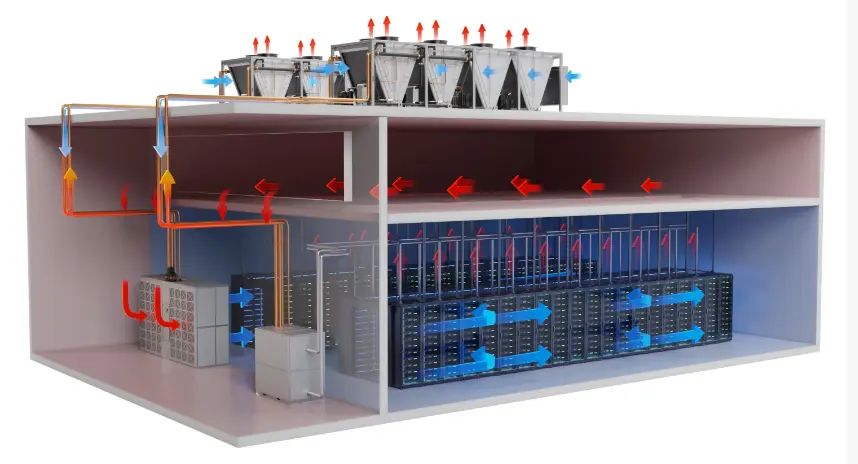
In conventional enterprise environments, servers operate at relatively lower power densities, allowing facilities to rely on computer room air conditioning (CRAC) units, massive chillers, and high-speed server fans to manage the thermal load. However, the architecture of an AI Data Center is fundamentally different.
Modern AI workloads rely on densely packed clusters of powerful CPUs and GPUs. As these components process complex algorithms, they convert vast amounts of electrical energy into heat. Air is a relatively poor conductor of heat. When rack power densities exceed 40 to 60 kilowatts (kW)—and continue pushing toward 100 kW to 150 kW—air simply cannot carry thermal energy away fast enough to prevent modern silicon from overheating and throttling its performance.
To prevent catastrophic failure and ensure reliable operation, heat must be removed at the source. This is where liquid cooling, leveraging the fundamental physics of heat transfer, becomes essential. Water and engineered dielectric fluids have roughly 3,000 times the volumetric heat capacity of air, making them vastly more efficient mediums for absorbing and transporting thermal energy.
How Direct-to-Chip Liquid Cooling Works
Direct-to-chip liquid cooling (also known as cold-plate cooling) is a highly targeted thermal management strategy. Rather than attempting to cool the entire volume of a server room or relying on air flowing through a chassis, this method captures heat directly at the component level.
The process involves a continuous, closed-loop cycle designed to maximize heat extraction from the most power-hungry processors:
- Heat Absorption at the Source: The core of the system is the cold plate, a specialized metal block (typically copper or a copper alloy) containing intricate internal micro-channels. These plates are mounted directly onto the integrated heat spreaders of the hottest components—CPUs, GPUs, and specific accelerators. A high-quality Thermal Interface Material (TIM) is applied between the chip and the cold plate to eliminate microscopic air gaps, ensuring maximum thermal conduction.
- Fluid Circulation: A specially formulated coolant (often a treated water-glycol mixture designed for freeze protection, corrosion inhibition, and biological control) is pumped through the micro-channels of the cold plate. As the fluid flows over the hot silicon, it rapidly absorbs the thermal energy.
- Heat Transport: The heated liquid exits the server chassis through secure, leak-resistant hoses equipped with quick-disconnect fittings. It travels to stainless-steel rack manifolds—supply and return headers that balance the fluid flow across multiple servers within the rack.
- Heat Exchange at the CDU: The warm coolant from the rack manifolds is delivered to a Coolant Distribution Unit (CDU). The CDU acts as the hydraulic and thermal bridge between the IT equipment and the facility’s cooling infrastructure. Inside the CDU, the heat from the secondary loop (the fluid cooling the servers) is transferred via a liquid-to-liquid heat exchanger to a primary facility loop (which may connect to chilled water systems, dry coolers, or closed-circuit cooling towers).
- Recirculation: Once the heat is transferred, the now-cooled fluid in the secondary loop is pumped back to the cold plates to repeat the cycle, maintaining the processors at optimal, stable temperatures.
While direct-to-chip systems handle the vast majority of the thermal load (up to 90%), residual heat from lower-power components like memory or storage drives is typically managed by a supplementary air-cooling system, creating a highly efficient hybrid cooling environment.
Comparison of AI Data Center Cooling Technologies
| Feature | Direct-to-Chip Liquid Cooling | Traditional Air Cooling | Immersion Cooling |
|---|---|---|---|
| Cooling Medium | Engineered Coolant / Water-Glycol | Air | Dielectric Fluid |
| Target Application | High-Density AI Data Center (60-150 kW/rack) | Standard Enterprise (5-20 kW/rack) | Ultra-High Density / Specialized Deployments |
| Heat Capture Efficiency | Excellent (captures heat at the source) | Poor to Moderate (cools ambient environment) | Excellent (entire server submerged) |
| PUE Potential | 1.15 or lower | ~1.5 – 1.8 | 1.05 – 1.15 |
| Hardware Maintenance | Standard chassis accessibility with fluid line management | Easy hot-swappable components | Complex; requires fluid draining and handling |
The Advantages of Direct-to-Chip Architectures
The transition to direct-to-chip cooling is driven by a convergence of performance requirements, economic factors, and sustainability goals.
1. Extreme Cooling Density and Unlocked Performance
The primary driver for liquid cooling is its ability to support the immense power densities of modern AI hardware. By efficiently removing heat from dense clusters, direct-to-chip systems prevent thermal throttling. Independent testing indicates that high-end AI systems can deliver significantly higher performance and maintain lower, more stable operating temperatures when liquid-cooled compared to air-cooled equivalents. This stability allows operators to maximize the computational output of their multi-million-dollar silicon investments.
2. Enhanced Server Density and Scalability
Because direct-to-chip systems remove heat so efficiently, data center operators can pack more servers into a single rack. This high-density approach allows facilities to deploy larger AI clusters within the same, or even a smaller, building footprint. It represents a major space saving and simplifies the complex networking required for scale-up architectures.
3. Transformative Energy Efficiency and PUE Reduction
Pumping liquid requires significantly less electrical energy than running massive CRAC units and high-speed server fans. By capturing heat at the source and utilizing higher coolant temperatures, direct-to-chip systems drastically reduce the reliance on mechanical chillers. This translates to Power Usage Effectiveness (PUE) ratings approaching 1.10, delivering substantial operational cost savings—often cutting cooling energy consumption by up to 90% compared to legacy systems.
4. Advancing Sustainability Goals
In 2026, sustainability is a strategic imperative. Closed-loop direct-to-chip systems conserve water through efficient design, often utilizing dry coolers that virtually eliminate the massive water evaporation associated with traditional cooling towers. Furthermore, the lower total energy consumption directly reduces the carbon footprint of the facility, helping organizations meet strict environmental regulations and ESG benchmarks.
The SOETECK AIDC Solution
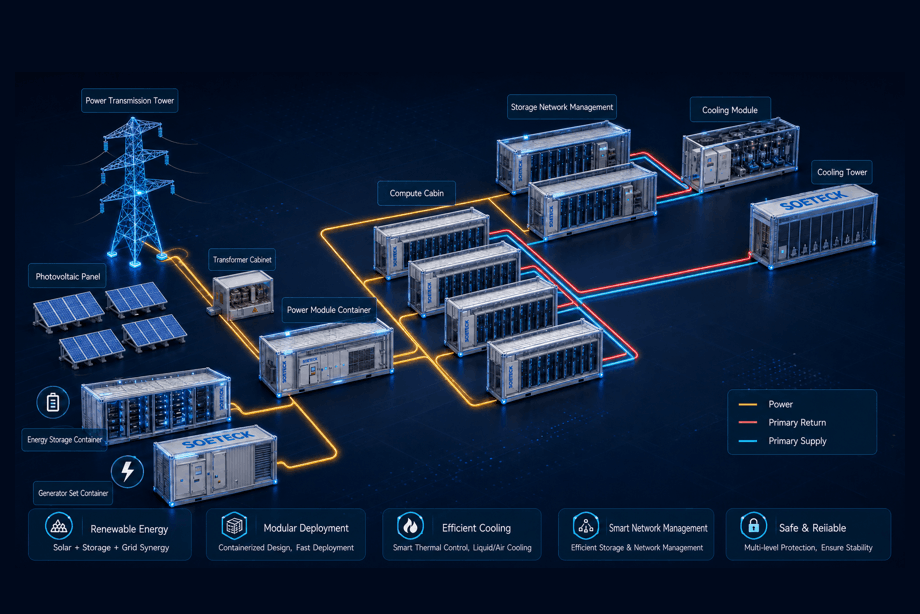
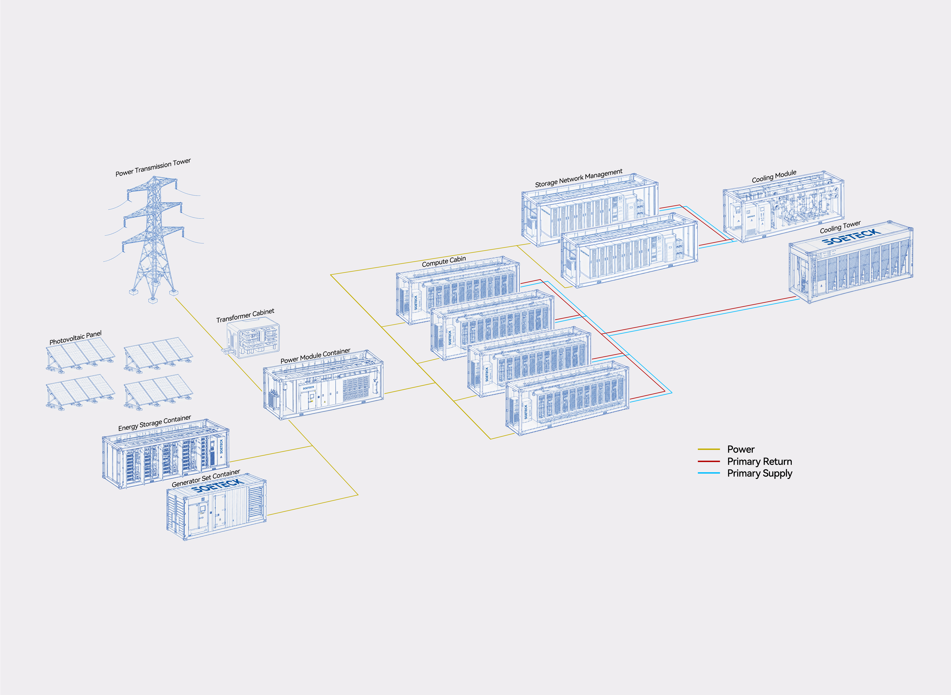
The SOETECK AI Data Center (AIDC) is a full-stack, single-vendor infrastructure solution purpose-built for ultra-high-load environments like AI training and supercomputing.
Key Highlights:
- Full-Stack Integration: A comprehensive five-layer architecture seamlessly combines massive compute (GB300 NVL72 GPUs) with AICoolit direct-to-chip liquid cooling, N+1 redundant power, and intelligent management.
- Extreme Cooling Density: Engineered to handle 60 to 150 kW per cabinet, the system removes 90% of heat directly at the source. It achieves a highly efficient PUE of 1.12, yielding 30–50% energy savings over traditional air cooling.
- Resilient Scalability: Built for continuous uptime despite harsh environments or unstable power grids, effortlessly scaling from pilot projects to multi-megawatt clusters.
- Rapid Delivery: Factory-prefabricated modular components cut deployment cycles by over 60%, reducing 6–12 month builds down to just 2–4 months.
Click here to learn what an AI data center is.
FAQ
Is there a risk of leaks with direct-to-chip liquid cooling systems?
While introducing liquid into a server environment naturally raises concerns, modern direct-to-chip systems are highly engineered to mitigate this risk. Solutions like the SOETECK AIDC utilize rigorous manufacturing standards, bidirectional self-sealing quick connectors, and robust materials (such as SUS304/SUS316L stainless steel pipes). Furthermore, they incorporate multi-layer, intelligent leak detection and monitoring systems at both the tray and rack levels to instantly identify and isolate any issues, ensuring the safety of the computing hardware.
How does direct-to-chip cooling affect data center maintenance compared to air cooling?
Direct-to-chip cooling changes the maintenance workflow but does not necessarily overcomplicate it. Unlike immersion cooling, where entire servers are submerged in fluid, cold-plate systems allow servers to remain in standard rack form factors. Technicians can still access components; however, they must manage fluid lines using quick-disconnects and occasionally reapply thermal paste when servicing specific processors. Comprehensive solutions provide integrated management software that simplifies monitoring and diagnostics.
Why is direct-to-chip liquid cooling considered necessary for new GPU clusters like the GB300 NVL72?
Next-generation AI hardware, such as the GB300 NVL72 architectures, feature incredibly dense chip configurations with very high Thermal Design Power (TDP) per chip. Traditional air cooling physically cannot move enough volume of air fast enough to dissipate this concentrated heat without the chips overheating and throttling performance. Direct-to-chip liquid cooling is necessary because it places a highly efficient heat-transfer medium (liquid) directly at the source of the heat, ensuring these massive multi-GPU configurations can operate at peak performance continuously.