PUE vs WUE in AI Data Centers
Release time: 2026-09-22
Table of Contents
The rapid proliferation of artificial intelligence has fundamentally altered the landscape of digital infrastructure. As AI workloads—driven by computationally intensive large language models and deep learning algorithms—scale at an unprecedented rate, the physical environments housing these workloads face profound structural challenges. Walk into a modern AI-ready facility, and the primary focus is no longer just the servers themselves, but the immense power required to run them and the complex thermal management systems needed to prevent them from melting down.
As these specialized facilities scale into the hundreds of megawatts, traditional metrics of efficiency are being stress-tested. Historically, the industry relied almost exclusively on a single metric to evaluate performance. However, energy efficiency is no longer defined solely by electrical consumption. It is now tightly intertwined with water dependency, long-term operating costs, regional policies, and broader sustainability goals. Today, evaluating the true environmental footprint of these megastructures requires understanding the critical balance—and often the inherent tension—between two vital benchmarks: Power Usage Effectiveness and Water Usage Effectiveness.
Understanding the dynamic of PUE vs WUE in AI data centers is no longer an academic exercise for facilities managers; it is a first-order design constraint, a business necessity, and a core component of modern ESG reporting.
Understanding the Foundational Metrics
To grasp the complexities of modern facility design, one must first understand what these metrics measure, where they originated, and why they are often at odds with one another.
PUE: The Gold Standard of Electrical Efficiency
Developed by The Green Grid in 2007, Power Usage Effectiveness (PUE) has long been the foundational metric for measuring how efficiently a facility utilizes energy.
The Calculation:
PUE is defined as the ratio of total facility power to the power consumed by IT equipment.
- PUE = Total Facility Energy ÷ IT Equipment Energy
A PUE of 1.0 represents a theoretical, unreachable ideal where 100% of the incoming electricity is devoted solely to computation (the servers, GPUs, and storage). In reality, a significant portion of incoming power is required to support the infrastructure surrounding that compute. This overhead includes power conversion losses, uninterruptible power supply (UPS) systems, lighting, and, most substantially, cooling systems.
A lower number indicates better electrical efficiency. Legacy enterprise server rooms often struggle with PUEs above 2.0 (meaning for every watt used by a server, another watt is used by overhead). Traditional, purpose-built facilities generally hover around 1.5. Today, leading hyperscalers and modern AI data centers strive for an ultra-efficient PUE of 1.2 or lower.
By capturing this overhead in a single tracking value, PUE allows operators to benchmark performance, identify electrical inefficiencies, and track the progress of their sustainability efforts over time.
WUE: Measuring the Liquid Footprint
While optimizing electricity is crucial, it only tells half the story. Recognizing that certain highly electrically efficient cooling designs were incurring a massive, unmeasured environmental cost, The Green Grid published Water Usage Effectiveness (WUE) in 2011 as a companion metric.
The Calculation:
WUE measures the ratio of annual site water use to the energy consumed by the IT equipment.
- WUE = Annual Site Water Usage (in liters) ÷ IT Equipment Energy (in kWh)
Unlike PUE, which focuses on electricity, WUE focuses on water consumption efficiency. This includes water used in evaporative cooling towers, adiabatic pre-cooling systems, humidification, and on-site power generation. A lower WUE reflects minimal water use relative to the computational workload capacity.
A facility utilizing purely mechanical, closed-loop cooling (like a chiller with no evaporation) can post a WUE near zero. However, facilities relying heavily on evaporative cooling—particularly in hot, dry climates where evaporation is thermodynamically attractive—will report much higher WUE values. The industry ideal for highly efficient facilities is generally considered to be below 0.2 L/kWh.
The AI Impact: Why These Metrics Matter Now More Than Ever
Early enterprise facilities improved their efficiency through straightforward operational changes: better airflow management, hot/cold aisle containment, and upgrading aging chillers. Modern data centers built for artificial intelligence face a completely different class of challenges.
AI workloads are uniquely resource-intensive. High-density GPU clusters introduce extreme localized thermal hotspots, rapid power transients, and a much tighter coupling between compute, power, and thermal management systems. Standard x86 servers might draw 300 to 500 watts; a single modern AI server rack can draw upward of 100 kilowatts.
This extreme power density means that AI applications often operate at near-full capacity continuously, generating an immense amount of heat. Removing this heat requires aggressive, highly engineered cooling topologies. Consequently, the energy and water consumption of these facilities has skyrocketed, making PUE and WUE essential benchmarks for responsible growth.
In water-stressed regions, local municipalities are increasingly pushing back against the massive water demands of new digital infrastructure. Water consumption has rapidly become a primary siting and permitting constraint. Operators can no longer simply optimize for cheap electricity if it means draining local reservoirs. They must report both metrics side by side, as a single-number efficiency story is incomplete without knowing which natural resource was traded to achieve it.
The Catch-22: The Trade-off Between Power and Water
Herein lies the core dilemma for modern infrastructure engineers: optimizing one metric often degrades the other. Understanding the relationship between these two benchmarks is akin to balancing top speed and fuel economy in a vehicle.
To cool high-density AI servers efficiently and achieve a low Power Usage Effectiveness, engineers often rely on evaporative cooling towers. Evaporation is highly energy-efficient because water possesses a large latent heat of vaporization—meaning it absorbs a massive amount of heat as it turns from liquid to gas. This process uses relatively little electricity, driving the PUE down. However, it consumes millions of gallons of water, driving the Water Usage Effectiveness drastically up.
Conversely, if a facility manager wants to minimize their liquid footprint and achieve a near-zero WUE, they must shift to air-cooled systems or mechanical chillers (dry coolers). These systems operate in a closed loop, rejecting heat to the outdoors without evaporation. While they save water, they require massive amounts of electricity to run heavy compressor fans. This significantly increases the facility’s electrical overhead, driving up the PUE and, consequently, increasing the Scope 2 carbon emissions at the power plant level.
This tension is the defining architectural challenge of the AI era. True operational efficiency comes only from balancing these factors based on specific facility design, localized energy strategies, and regional climate conditions.
Strategies for Achieving Balance
As the industry matures, extreme optimization of a single metric is being abandoned in favor of sustainable equilibrium. Data centers housing modern compute are increasingly adopting sophisticated architectures to harmonize their resource consumption.
1. Hybrid Cooling Architectures
Rather than relying solely on one method, operators are deploying hybrid systems. These intelligent architectures utilize “water consumption on demand.” They leverage free air cooling (using cooler outside air) during winter months or cooler nights, maintaining a great PUE without using water. Evaporative cooling is only activated during peak summer heat conditions. This approach minimizes annual water use while keeping electrical overhead controlled during high-load periods.
2. The Shift to Liquid Cooling
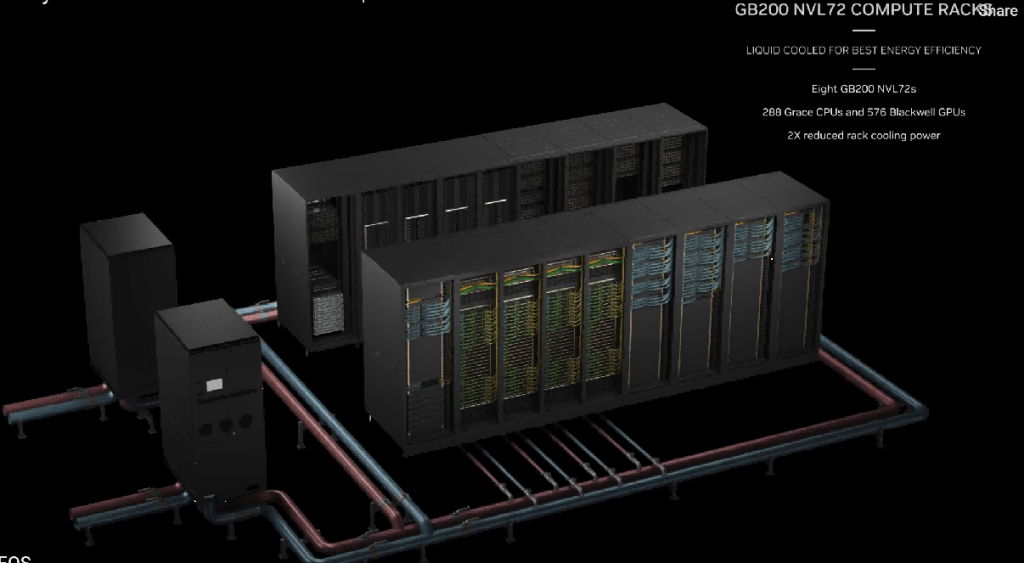
Air cooling simply cannot keep up with the thermal output of next-generation GPUs. The industry is rapidly transitioning to liquid cooling technologies, such as direct-to-chip cooling and rear-door heat exchangers. Liquids are vastly more efficient at capturing and transferring heat than air.
These liquid-cooled systems allow facilities to operate with higher return water temperatures. Because the water returning from the servers is hotter, it is easier to reject that heat to the outside atmosphere using dry coolers, even in warm climates, without resorting to evaporation. Liquid cooling is becoming the foundational technology that allows facilities to maintain exceptional electrical efficiency while drastically cutting water dependency.
3. Advanced AI Water Management and Treatment
Facilities are also optimizing the water they do use. Implementing Advanced Oxidation Process (AOP) water treatment keeps cooling towers cleaner, reducing scaling and biofilm. This allows the system to run at higher cycles of concentration (CoC)—meaning the same water can be cycled through the system more times before it must be flushed (blowdown).
Furthermore, operators are utilizing AI-driven predictive analytics. These models forecast cooling loads based on computational demand and weather forecasts, adjusting valve operations and make-up water needs in real-time to prevent waste.
4. Heat Recovery and Reuse
The ultimate way to improve both metrics is to transform waste heat from a liability into an asset. Some advanced facilities are implementing heat recovery systems that capture the high-grade heat generated by liquid-cooled AI servers and export it to local district heating networks to warm nearby homes, greenhouses, or commercial buildings. By reusing this energy, the facility effectively “discounts” its overhead, creating a win-win scenario for overall sustainability.
5. Utilizing Non-Potable Water
To alleviate the strain on municipal drinking water, responsible operators are increasingly leveraging recycled water, gray water, or even treated wastewater for their cooling towers. While this doesn’t technically lower the facility’s WUE score (as water is still being consumed), it drastically reduces the impact on the local community’s vital freshwater supply.
PUE vs WUE Comparison
To quickly understand how these metrics differ and interact, consider the following comparison:
| Feature | PUE (Power Usage Effectiveness) | WUE (Water Usage Effectiveness) |
|---|---|---|
| What it measures | Ratio of total facility electricity to IT equipment electricity. | Ratio of annual site water used to IT equipment electricity consumed. |
| Primary Resource | Electricity (measured in kWh) | Water (measured in Liters) |
| Ideal Score | 1.0 (Theoretical minimum) | 0.0 (Achievable with non-evaporative cooling) |
| Current AI Benchmarks | ~ 1.15 to 1.3 | < 0.2 L/kWh (Highly dependent on climate/design) |
| Primary Driver | Cooling infrastructure power, lighting, power distribution losses. | Evaporative cooling towers, humidification. |
| The Trade-off Effect | Lowering this often requires evaporative cooling, which increases water use. | Lowering this often requires mechanical dry cooling, which increases electricity use. |
| Why it’s critical now | AI GPUs demand massive power, stressing regional electrical grids. | Massive water consumption for cooling limits siting in water-stressed regions. |
Conclusion
The era of evaluating digital infrastructure through a single lens is over. As artificial intelligence continues to drive exponential growth in power density, the tension between PUE vs WUE in AI data centers will only intensify.
Operators can no longer afford to view electricity and water as isolated line items. They must be managed as a unified, tightly coupled ecosystem. The most successful and sustainable facilities of the future will not necessarily be those that boast the absolute lowest PUE, but rather those that intelligently balance electrical efficiency with responsible water stewardship, utilizing advanced liquid cooling, AI-driven automation, and hybrid designs to meet the complex demands of the AI revolution without depleting the resources of the communities in which they operate.
FAQs
1. Can a data center achieve both a low PUE and a low WUE simultaneously?
Achieving both is challenging but increasingly possible, though it requires significant capital investment. Traditionally, these metrics trade against each other. However, by utilizing advanced direct-to-chip liquid cooling—which captures heat so efficiently that it produces high-temperature return water—facilities can reject heat to the atmosphere using dry coolers (zero water) while using minimal compressor energy (low electricity). This, combined with operating in cooler climates, allows for excellent performance across both metrics.
2. How does liquid cooling impact the balance between energy and water use?
Liquid cooling is the key to breaking the traditional catch-22. Because liquid transfers heat significantly better than air, it requires less energy to move (pumping liquid is more efficient than running massive air fans), which improves PUE. Furthermore, because it captures heat more effectively, it reduces or eliminates the need for evaporative cooling towers, which drastically lowers the WUE. It is the essential technology for sustainable, high-density AI infrastructure.
3. Why are municipalities paying closer attention to a facility’s WUE?
As AI workloads scale, the sheer volume of water required by traditional evaporative cooling systems has become staggering—sometimes millions of gallons a day per facility. In regions experiencing drought or chronic water scarcity, this puts digital infrastructure in direct competition with local agriculture and residential drinking water supplies. Consequently, local governments are increasingly demanding strict WUE disclosures and prioritizing the permitting of facilities that utilize closed-loop, zero-water cooling designs.